Johor Bahru sells across a causeway. The sales gallery is in JB; a large share of the buyers and the agents are in Singapore, with more in Hong Kong, China, and the wider region. The usual way to reach them is to email a set of materials to a dozen agencies in three markets, and hope everyone presents the current version. They do not. The materials age at a different speed in each inbox, and the buyer's first impression depends on which agency reached them first.
A digital sales gallery replaces the emailed folder with one live link. Every agent presents the same current project, and every lead comes back to one place.
The Johor Bahru context: built to sell outward
Johor's growth corridors are designed for cross-border demand. A development such as Forest City in Iskandar Puteri, spanning roughly 7,000 acres across four islands and designated a Special Financial Zone, is marketed heavily to buyers beyond Malaysia. Across Iskandar Puteri, projects routinely sell through agency networks in Singapore and further afield. This outward reach is a strength, and it is exactly what static distribution handles worst.
A brochure is a snapshot. Sent to fifteen agencies in three markets, it becomes fifteen snapshots aging independently, and the developer has no way to know which buyer saw which version.
Why the emailed brochure works against cross-border sales
The distribution problem has a predictable shape. Materials go stale, so an agency shares an availability list from last week and a buyer enquires about a unit that sold over the weekend. Presentation varies, so the same project looks polished from one agency and like a forwarded PDF from another. And attribution blurs, so when a buyer contacts two agencies about the same unit, both claim the lead and the developer cannot see the real journey. The full operating model for managing agencies across Singapore, Hong Kong, and ASEAN goes deeper on the coordination side; here the focus is the gallery the buyer actually opens.
Across a border, a snapshot is out of date before it lands. Cross-border selling needs a live source, not a faster way to send stale files.
One live gallery, every channel
A digital sales gallery gives every channel the same current experience:
- The interactive master plan shows the development, its buildings, and its units, with availability live on each one.
- The same link runs on the JB gallery's screen, in a Singapore agent's briefing, and in a WeChat or WhatsApp message to an overseas buyer.
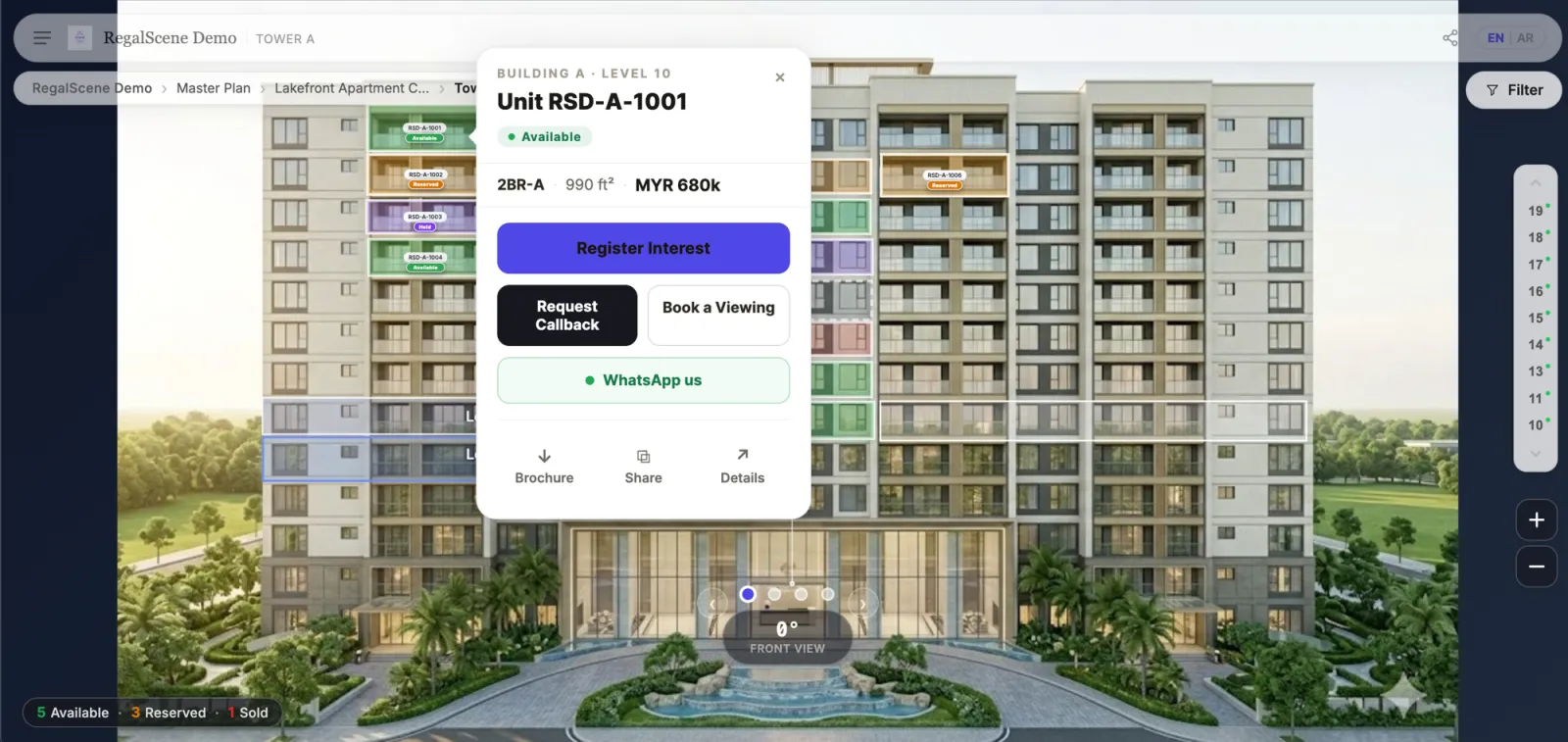
- A buyer explores from the master plan down to a single unit, sees its price under the developer's display policy, and enquires from the unit itself. The buyer journey behind this is the same interactive master plan a Johor township uses.
- Every lead returns to one system with the agent and unit attached, so the pipeline is visible across all markets at once.
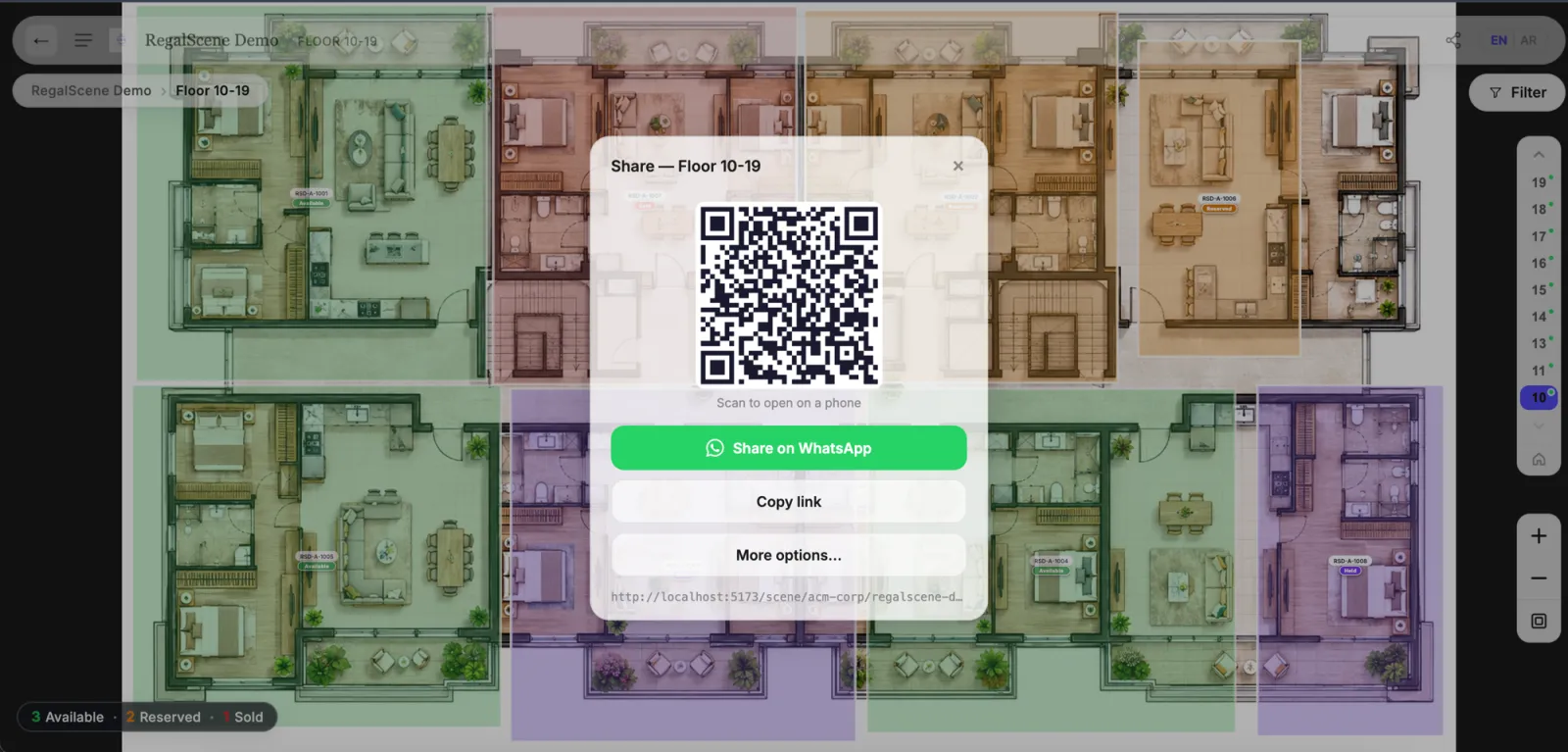
Because it is a link, distribution is a share, not a mailout. An agent sends a QR code or a message, the buyer opens the live project, and the developer keeps one current source behind all of it. This is the same shareable link and QR approach that carries a project through WhatsApp, WeChat, and Line.
Forest City and the other developments named above are not RegalScene projects. They stand only as public examples of Johor Bahru's cross-border scale.
The leads arrive knowing what they are about
The value of a digital sales gallery shows in the enquiry. Because each unit is linked, a lead sent from the gallery carries which building, which unit, and what the buyer explored on the way, whether they were browsing from Singapore or standing in the JB gallery. The sales team receives an enquiry that already knows its subject, rather than a name and a phone number. For buyers reached through overseas agents, this context is often the only signal the team has before the first call, which makes it worth selling to Chinese and other overseas buyers through a digital experience rather than a static deck.
A cross-border gallery does not mean more scenes
Reaching several markets does not multiply the build. RegalScene prices by active scene capacity, and a scene is a meaningful authored view, not a market or an agency. The same set of scenes serves Singapore, Hong Kong, and local buyers at once, in the same link. Adding an agency or a market adds distribution, not scenes. The logic of pricing by scenes rather than units covers this, and the current figures are on the pricing page.
More markets and more agencies do not raise the scene count. They share the same live experience.
What this asks of the developer
Three things make a cross-border digital gallery work. Availability has to be live and central, so every market sees the same truth at the same moment. The display policy stays the developer's decision, so pricing is disclosed on the developer's terms whether the buyer is local or overseas. And access has to be controllable per agency, so the developer decides which partner sees which project while every lead still returns to one place.
For a Johor Bahru developer selling across a border, the digital sales gallery is what makes the gallery reachable without the causeway, and what keeps every agent honest to the same current project.
See your project sold across the border
The fastest way to judge this is on a project you are selling now. Bring a master plan and a unit schedule, and watch a buyer in another city move from the master plan to a single available unit to an enquiry, in a browser, on a phone.
Related reading:
- Property Marketing in Malaysia: Virtual Sales Galleries and Multi-Agency Sales
- Interactive Master Plans for Township Sales in Johor
- Property Sales Distribution in Singapore: Working With Agencies
- Selling Property to Chinese Buyers Digitally
- Shareable Interactive Property Links: QR, WhatsApp, and More
RegalScene turns the master plans and floor plans Johor Bahru developers already have into one digital sales gallery that reaches every market from one link. See the platform or tell us about your project.