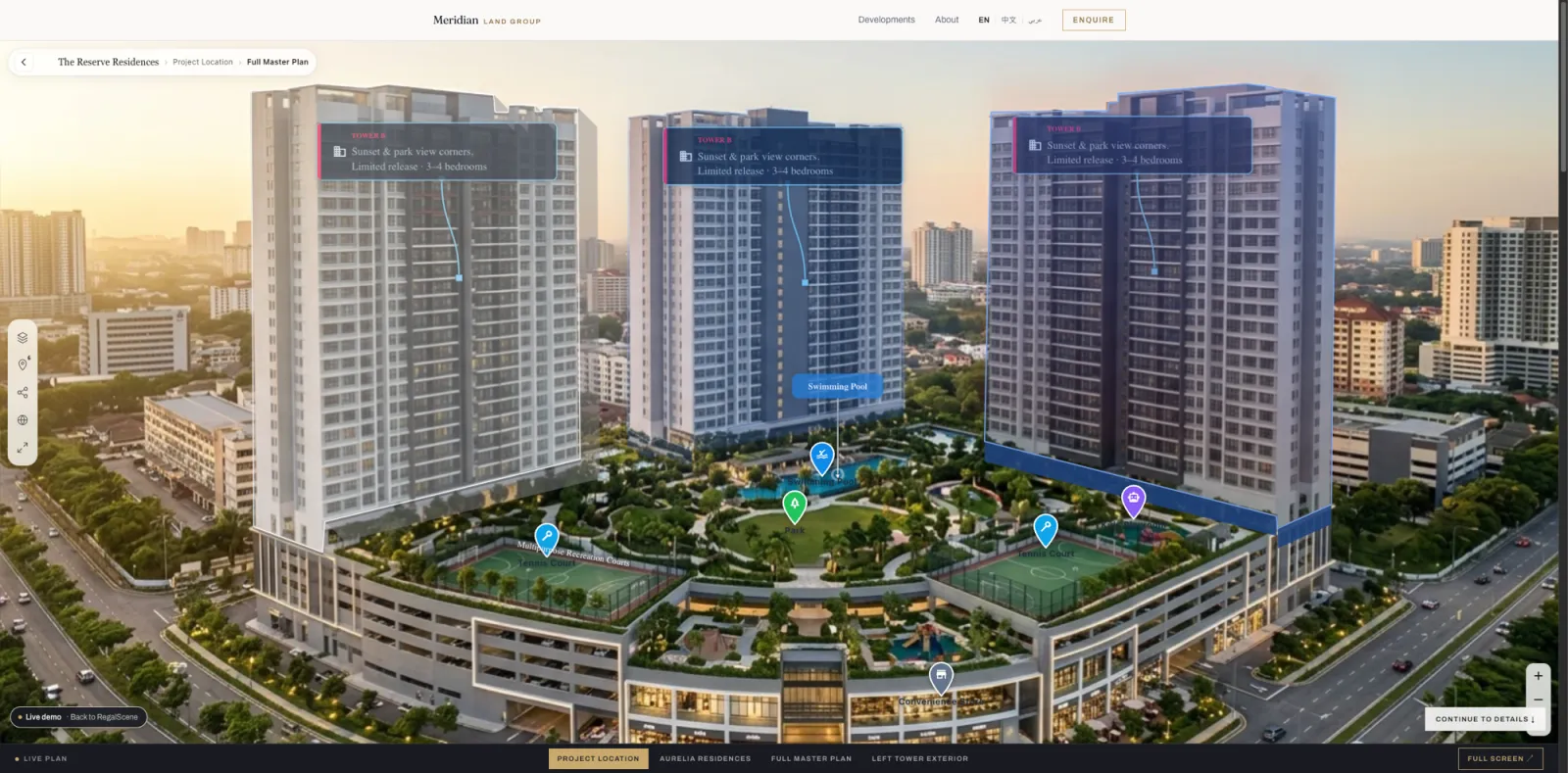
On the Penang waterfront, two apartments on the same floor are not the same product. One faces the sea and one faces the road, and the difference is most of the price. Buyers know this, and they ask about it first. A static brochure answers with a compass rose and a paragraph, and leaves the buyer to imagine the view. On the water, that is the one thing they will not take on trust.
Penang's constrained island land makes this sharper than most markets. Sites are tight, developments go up rather than out, and reclamation projects create precincts where position, height, and outlook decide value. This is where an interactive experience does something a render cannot: it lets a buyer find their view.
The Penang context: waterfront, high-rise, and tight land
Penang's signature developments sit on and beside the water. A development such as Seri Tanjung Pinang's second phase, a master-planned seafront project at Tanjung Tokong, is organized into packages, with its Package 2A covering roughly 253 acres of reclaimed land. Along Gurney Drive, the Gurney Wharf reclamation adds around 131 acres of public seafront across four distinct character areas. These are public examples of a pattern: precincts defined by their relationship to the water, and buildings whose value turns on which way they face.
On land this constrained, developments are dense and vertical, and the units that matter most are the ones with the outlook. A flat plan cannot rank them. An interactive experience can.
Why static assets struggle on the waterfront
A waterfront brochure has to describe three things a buyer cannot read off a picture: where a unit sits in the development, how high it is, and what it looks out on. Static assets handle none of them well. The site plan shows the precinct but not the unit. The floor plan shows the layout but not the view. The render shows one hero angle, usually the best one, and says nothing about the unit the buyer is actually being offered.
The result is a buyer who likes the project and cannot commit to a unit, because the one question that decides it, what will I see, has no answer on paper. The reasons static brochures fail apply everywhere, but on the water they decide the sale.
On the waterfront, the buyer is not choosing an apartment. They are choosing a view, and static assets cannot show it to them.
A discovery journey where position is the point
An interactive experience turns position into something a buyer explores:
- Master plan. The development on the coastline, precincts outlined, the water as the organizing landmark, amenities and frontage marked.
- Precinct. A precinct opens to its buildings, each placed in relation to the sea and the shared spaces.
- Building. On the building view, units are drawn on the actual facade, so the sea-facing and inland units are visible at a glance, each with live availability.
- View. A 360 view from a floor shows the outlook itself, so a buyer sees the water rather than reading about it.
- Unit and enquiry. The unit carries its plan, orientation, price under the display policy, and the way to enquire, with the lead attached to that exact unit.
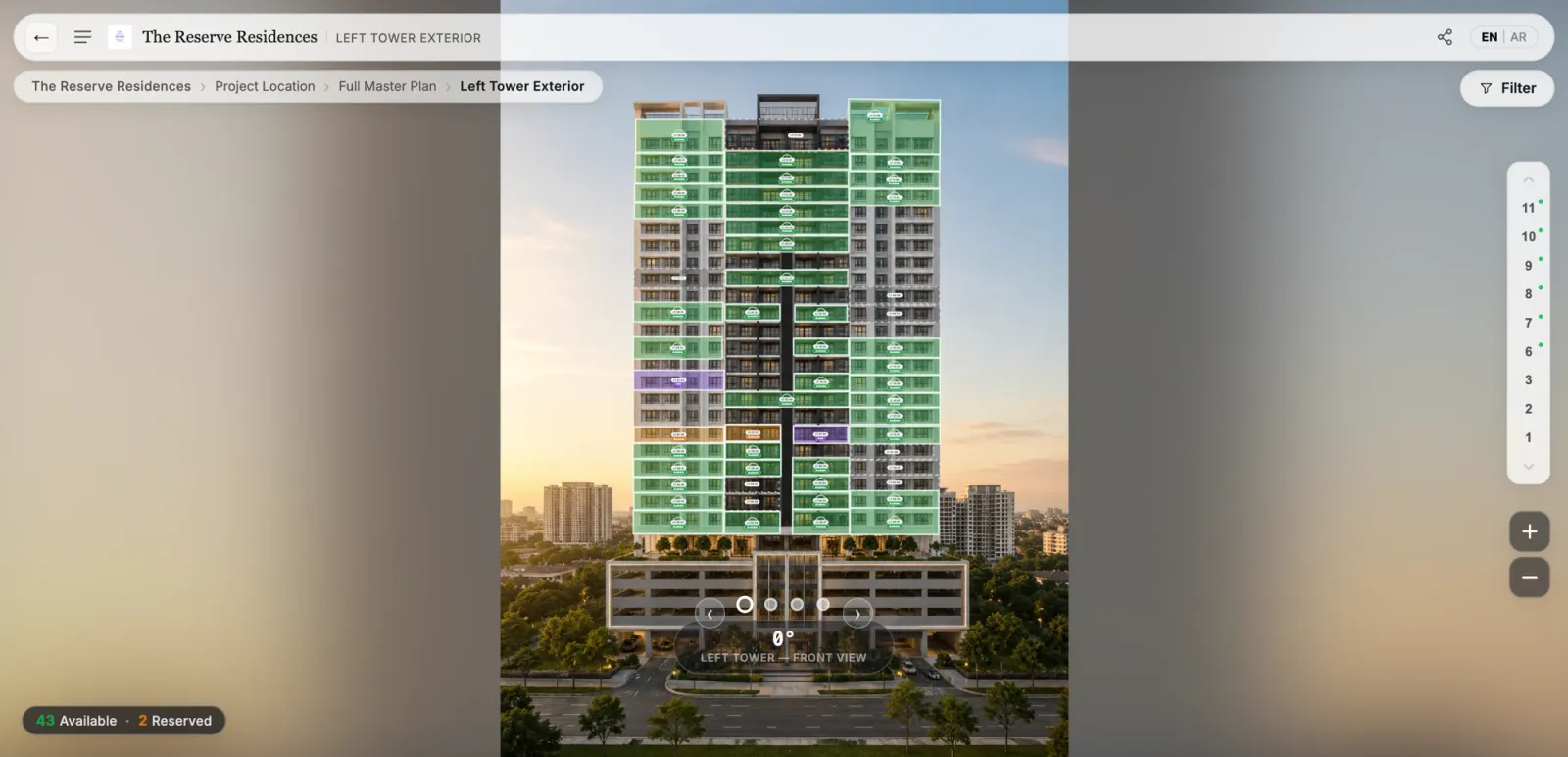
A buyer moves from the coastline to a single sea-facing apartment that is still available, following the same map, building, floor, and unit structure throughout. Where the outlook carries the value, a 360 building explorer lets the buyer stand at the height they are buying and look out.
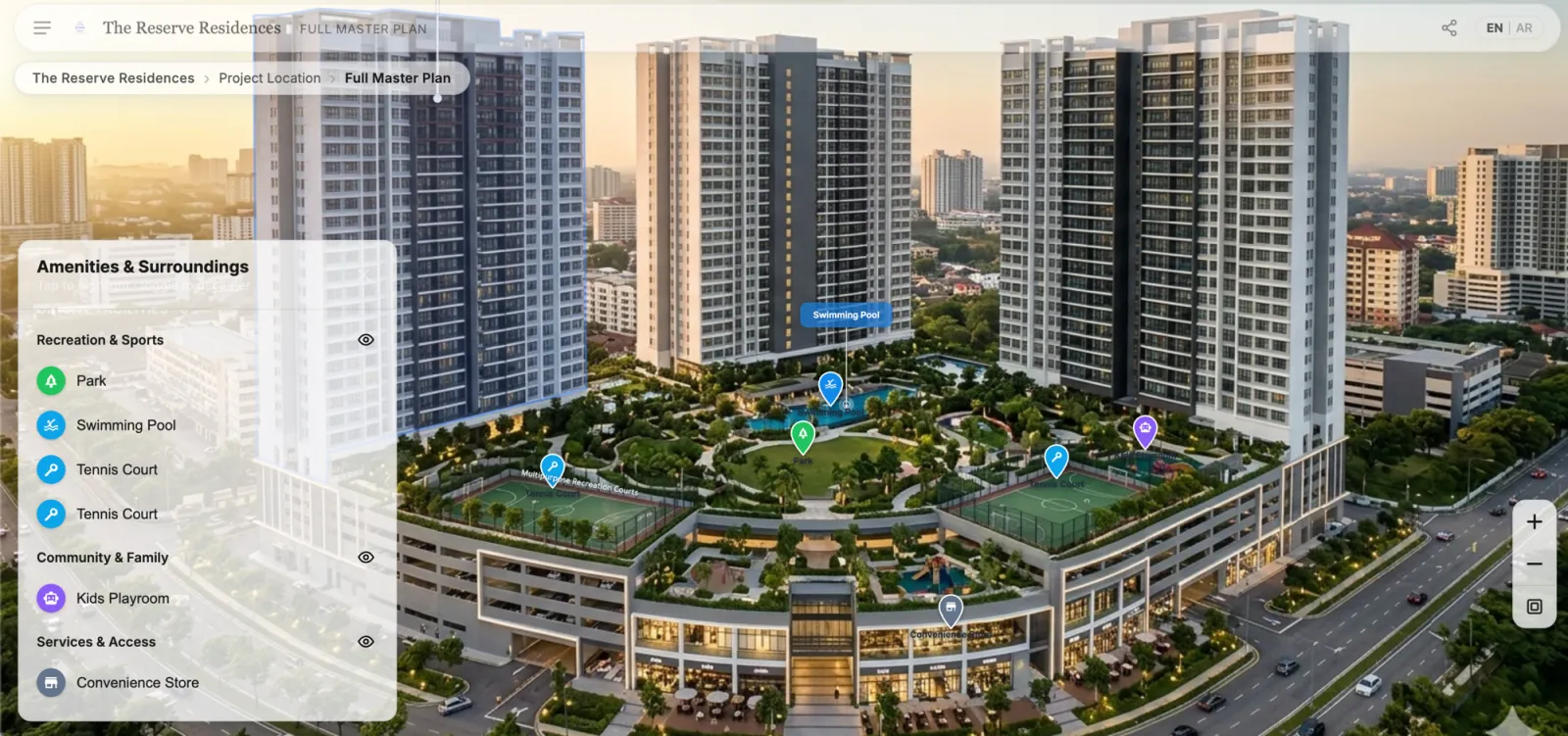
The developments named above are not RegalScene projects. They stand only as public examples of Penang's waterfront and high-rise scale.
A large waterfront project does not mean many scenes
Reclaimed precincts and multiple towers can look like a large build to put online. By scene count, they need not be. RegalScene prices by active scene capacity, and a scene is a meaningful authored view, not a unit. A waterfront development could begin with one master-plan scene and add depth only where position sells the unit: a building view where the facade matters, a 360 outlook from a key floor, a precinct aerial where the frontage is the story.
Hundreds of apartments sit as inventory on a handful of scenes. The logic of pricing by scenes rather than units explains why, and the current figures are on the pricing page.
Reclaimed acres and tower counts do not set the cost. The views worth authoring do.
Built for the phone, and the buyer who is elsewhere
Penang sells to buyers across Malaysia and abroad, often deciding from a phone. The experience opens in a normal browser from one link, with nothing to install, and a dense waterfront project loads quickly on a standard smartphone for the reason large master plans stay fast in a browser. The same link works on the sales gallery screen, in an agent's message, and on the buyer's own phone, always showing which sea-facing units remain.
What this asks of the developer
Three things make a waterfront experience work. Units need position and orientation held as real attributes, not buried in a brochure, so the facade view and the outlook mean something. Availability has to be live, so a buyer chasing the last sea-facing unit sees the truth. And the display policy stays the developer's decision, so pricing is disclosed on the developer's terms across every channel.
For a development where the premium units are defined by their view, letting buyers find that view online is not a marketing extra. It is how the most valuable units get sold first.
See your waterfront project made explorable
The fastest way to judge this is on a building you are selling. Bring a site plan, a facade, and a unit schedule, and watch a buyer move from the coastline to a single sea-facing apartment to an enquiry, in a browser, on a phone.
Related reading:
- Map, Building, Floor and Unit Views: How to Present a Project Online
- 360 Building Explorer: Virtual Tours That Sell the View
- Presenting Penang Mixed-Use Developments Online
- Why Static Brochures Fail in Real Estate
- How Massive Master Plans Stay Fast in a Normal Browser
- Why RegalScene Prices by Scenes, Not Units
RegalScene turns the master plans, facades, and floor plans Penang developers already have into one interactive experience, from coastline to unit, in any browser. See the platform or tell us about your project.