Dubai sells a lot of property that does not exist yet. Off-plan is the core of the market, and it asks the buyer to do something hard: commit to a home from a render and a floor plan, often from another country, before a single wall is built. The usual toolkit for that is a PDF brochure, a price list in a separate file, and an availability sheet that ages by the weekend. None of it answers the buyer's real questions. Which units are still available? What does this one look out on? Where is it in the development?
When the product is a promise, the experience of exploring it is much of what the buyer is actually buying. That is where an interactive experience does what static assets cannot.
The Dubai context: off-plan, at scale, sold worldwide
Dubai's launches are large and international. A development such as Dubai Creek Harbour, a roughly 6-square-kilometer waterfront master plan organized into nine districts, or Palm Jebel Ali, spanning about 13.4 square kilometers across sixteen fronds, is sold to buyers across the Gulf, South Asia, Europe, and beyond, mostly off-plan. Dubai Hills Estate mixes townhouses, villas, and apartments in one master community. These are public examples of the shape Dubai development takes: big, multi-district, and released in phases to a global audience.
That audience rarely stands in the sales gallery. It explores from a phone in another city, which is exactly the situation static collateral handles worst. RegalScene is not affiliated with, engaged by, or endorsed by any development named here; they appear only as public examples of scale.
Why static assets fail off-plan buyers
Off-plan buying already asks for trust. Static assets spend that trust instead of building it. The render shows one hero angle, usually the best one, and says nothing about the specific unit on offer. The floor plan lives in one document, the price and availability in another, so a buyer who likes a unit still cannot tell whether it is available without messaging an agent, who checks a sheet, who checks with the office. By the time the answer comes back, a decisive buyer has moved on.
The reasons static brochures fail apply everywhere, but off-plan sharpens them: there is no show unit to walk, so the digital experience is the product tour. If it cannot show what remains and where, the buyer has nothing solid to hold.
Off-plan, the buyer is committing to an experience of the project. If that experience is a PDF, so is their confidence.
The off-plan buyer journey, made explorable
An interactive experience turns the promise into something a buyer walks themselves:
- Master plan. The development from above, districts outlined and clickable, phases marked, the waterfront or the parkland as landmarks.
- District and tower. A district opens to its towers; a tower opens to a stacking plan banded by availability.
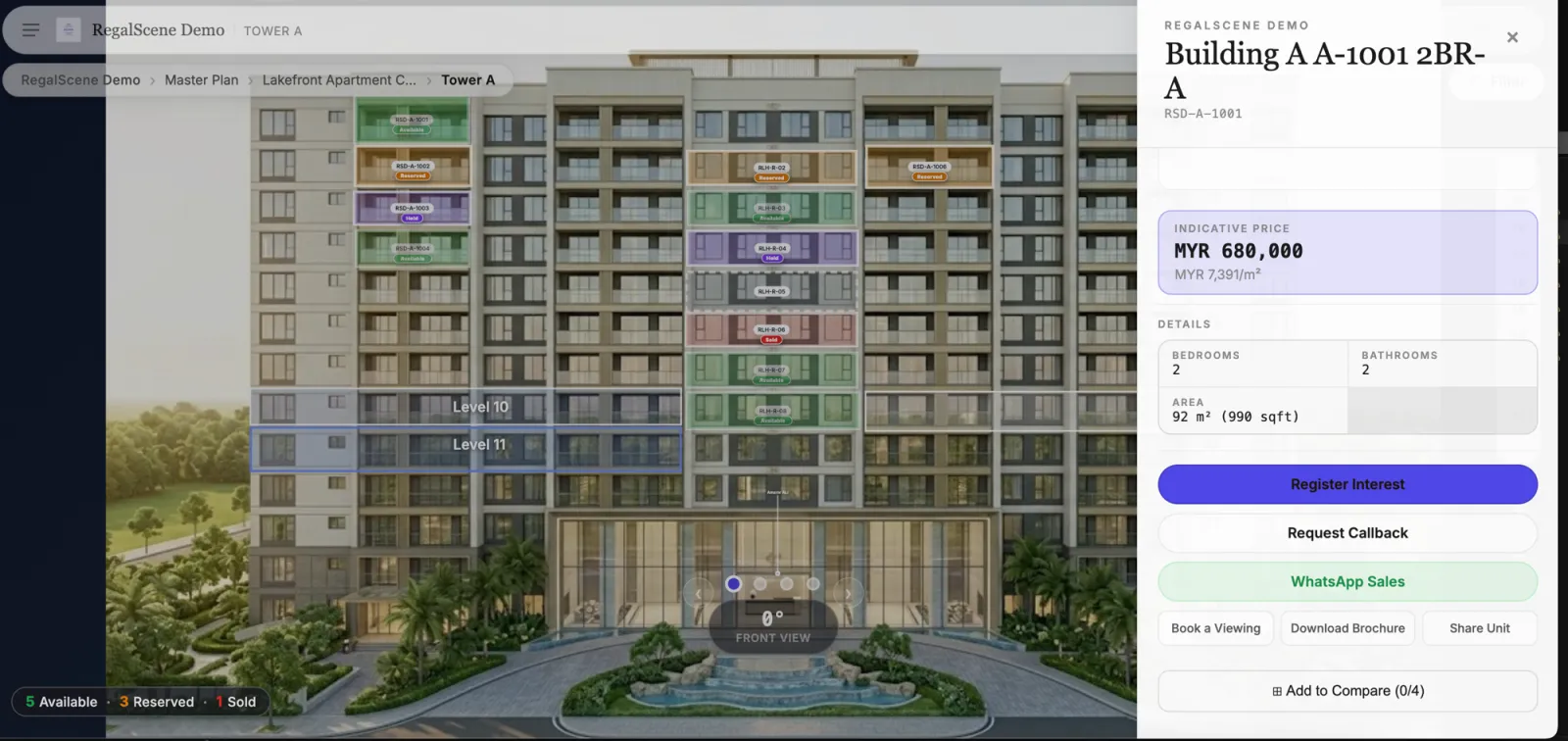
- Floor and unit. A floor plate shows units in place; a unit shows its layout, orientation, view, and price under the developer's display policy.
- Enquiry. The buyer enquires from the unit, and the lead carries which district, tower, floor, and unit they were on.
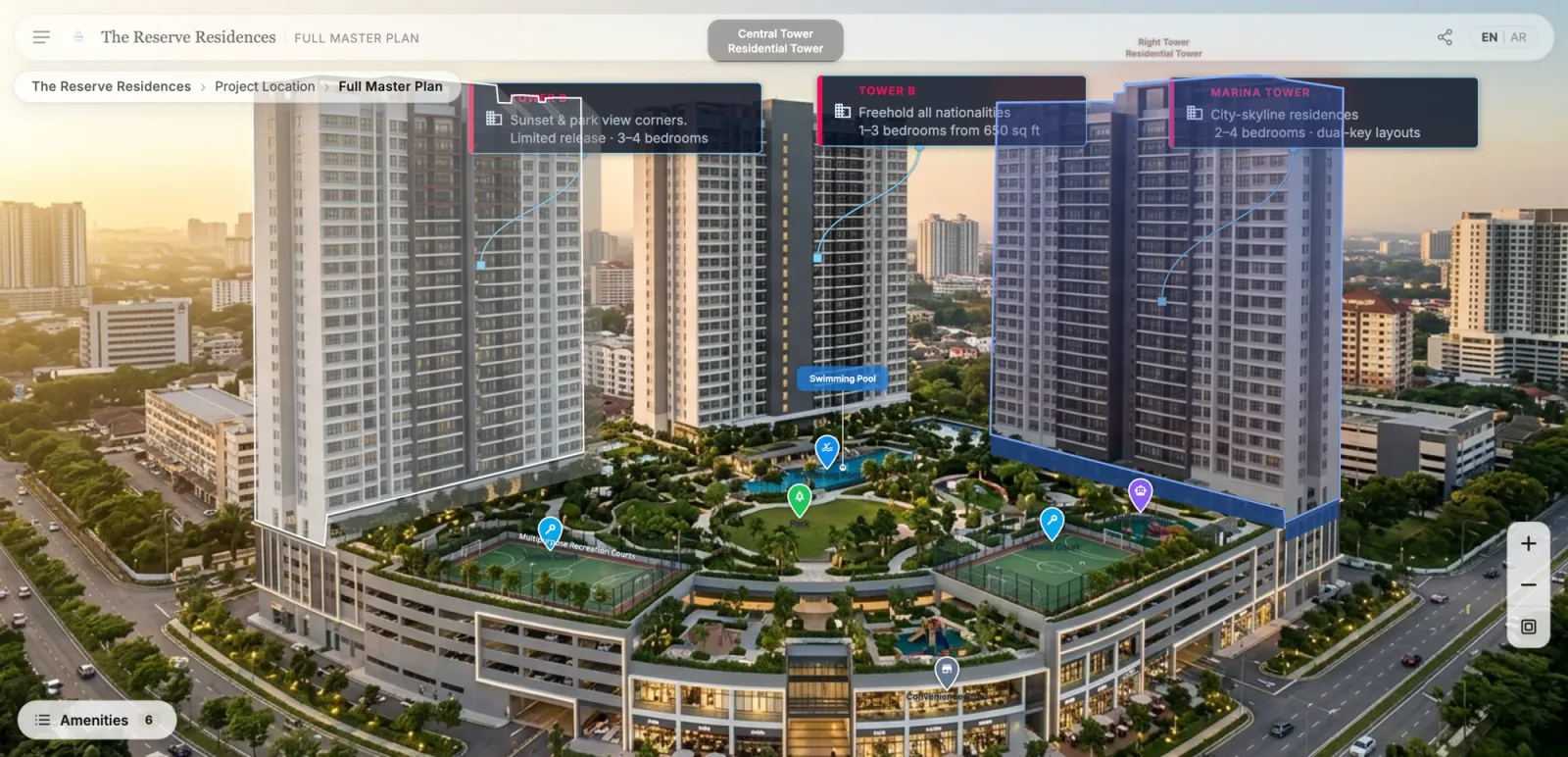
From the whole development to a single available apartment in about a minute, following the same map, building, floor, and unit structure throughout. For an off-plan launch, this is also the difference between selling off-plan digitally and emailing a brochure: the buyer sees what is left, not a snapshot from last week.
The international buyer, reached by a link
A Dubai off-plan buyer is often deciding from abroad. The experience opens in a normal browser from one link, with nothing to install, and a large multi-district development loads quickly on a standard smartphone for the reason large master plans stay fast in a browser. The same link works on the gallery touchscreen in Dubai, in an agent's WhatsApp message, and on the buyer's own phone in another country, always showing current availability. The gallery visit that used to require a flight becomes a link the buyer opens first, and the flight, if it happens, comes later and warmer.
A large development does not mean a heavy build
Dubai's scale can look like a large, expensive thing to put online, district by district and tower by tower. It need not be. RegalScene prices by active scene capacity, and a scene is a meaningful authored view, not a unit or a floor. A development could begin with one master-plan scene and add depth only where buyers want it: a district aerial, a tower's stacking plan, a 360 view from a high floor.
Thousands of off-plan units sit as inventory on a handful of scenes. The reasoning behind pricing by scenes rather than units explains why the number of apartments does not drive the price, and the current figures are on the pricing page.
Physical scale does not set the cost. The depth of the buyer journey does.
What this asks of the developer
Three things make an off-plan experience hold up. Availability has to be the live source of truth, so a reserved unit reads as reserved the moment the team updates it, across every market at once. The display policy has to be the developer's decision, so whether prices show to buyers or only to agents is set centrally. And the experience has to carry every phase in one link, so a later tower publishes into the same place the first buyers already bookmarked, with no new microsite per launch.
For a launch sold to a global audience before it is built, the interactive experience is not a marketing extra. It is the show unit, open every hour, in every market.
See your off-plan development made interactive
The fastest way to judge this is on a tower you are launching. Bring a master plan and a unit schedule, and watch a buyer in another city move from the development to a single available apartment to an enquiry, in a browser, on a phone.
Related reading:
- Selling Off-Plan Property Digitally: Reducing Buyer Uncertainty
- Interactive Master Plans for GCC Property Sales
- Map, Building, Floor and Unit Views: How to Present a Project Online
- How Massive Master Plans Stay Fast in a Normal Browser
- Why RegalScene Prices by Scenes, Not Units
RegalScene turns the master plans, renders, and floor plans Dubai developers already have into one interactive off-plan sales experience, from master plan to unit, in any browser. See the platform or tell us about your project.