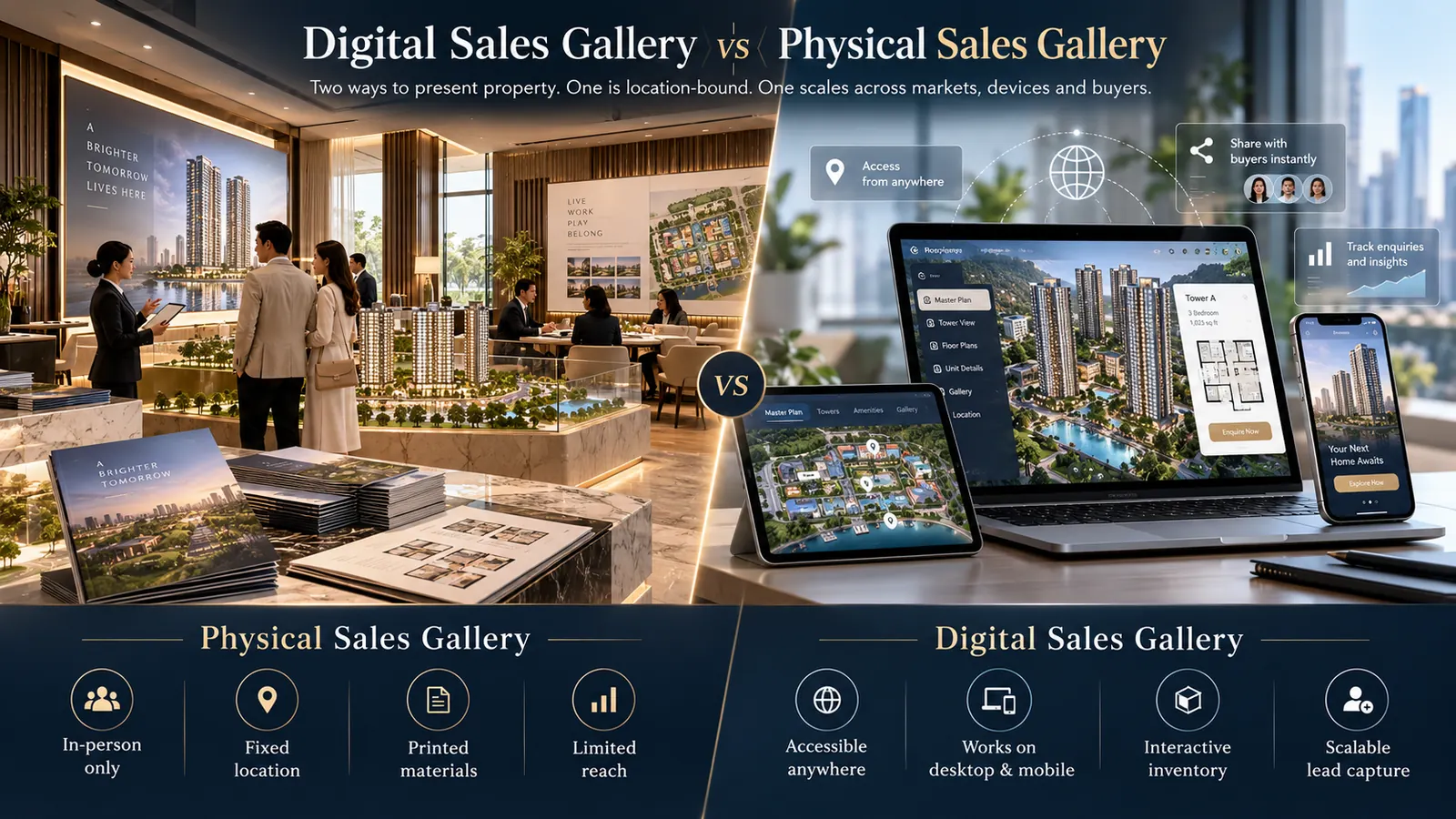
A physical sales gallery is a showroom at one location, with a scale model, show units, printed material and consultants. A digital (or virtual) sales gallery puts the same project online: buyers explore the master plan, the buildings, the floors and the units on any device, see current availability and enquire about a specific unit. Most developers need both, because each does a job the other cannot.
What is a sales gallery?
In real estate, a sales gallery is the place where a developer presents a project to buyers, usually before it is built. It goes by several names (show gallery, sales office, sales center) but the contents are familiar: a scale model of the development, furnished show units, floor plans and price lists, and consultants who walk buyers through it. It is often a purpose-built showroom on or near the site that opens for the launch.
Its job is simple: help a buyer understand a project that does not exist yet well enough to commit. A digital sales center does that same job online, which is where the comparison below begins.
Physical sales galleries have been the cornerstone of property launches for decades. A well-designed showroom creates a tangible connection between the buyer and the development. But it has limits that a digital gallery removes.
| Physical sales gallery | Digital sales gallery | |
|---|---|---|
| Where buyers see it | At one location, in opening hours | Anywhere, at any hour, on any device |
| Who it reaches | Buyers who can visit | Local buyers, buyers abroad, family members they share it with |
| Unit availability | A printed list or the consultant's sheet | Current status on the building and floor itself |
| Capacity | As many buyers as there are consultants | Unlimited, at the same time |
| What the sales team gets | The consultant's notes | A lead with the unit, the source and the buyer's steps |
| Best at | Closing: the model, the show unit, the conversation | Reach, qualification and follow-up before and after the visit |
Can a digital masterplan replace the scale model?
This is the question developers actually ask, and the honest answer is no, not for the thing the model is best at.
A scale model gives a buyer the physical sense of a development in a few seconds: how the towers sit together, how big the park really is, where the sun falls. It does that better than any screen, in a room with someone who can answer the next question. That is why galleries are built around it.
What a scale model cannot do is change. It is accurate on the day it is finished. It cannot show which units are still available, it cannot be filtered down to a buyer's budget or a north-facing three-bedroom, it cannot be sent home to a spouse, and it exists in exactly one building.
So the two are not competing. The model carries the development; the screen carries the inventory.
The screen does not replace the model. It replaces the printed price list beside it.
Limitations of physical-only sales
Reach
A physical gallery serves buyers who can physically visit. For developments targeting international buyers, diaspora investors, or simply busy professionals, the gallery is only accessible during operating hours at one location.
Capacity
A sales gallery can serve a limited number of visitors at a time. During launch weekends, queues form. During quiet weeks, the gallery sits empty. The investment is the same either way.
Information depth
Scale models show the development at a high level. Printed floor plans show unit layouts. But buyers can't easily compare units across floors, check current availability, or zoom into specific areas without sales consultant assistance.
Measurement
It's difficult to measure what happens in a physical gallery. Which units attracted the most attention? Which floor plans were picked up most? Where did buyers lose interest? The data is anecdotal at best.
What a digital sales gallery adds
A digital sales gallery is not a replacement for a physical showroom — it's an extension that removes the limitations.
Always open, everywhere
Buyers explore the development from any device, any time, anywhere. The digital experience works before, during, and after a physical visit.
Self-paced exploration
Buyers navigate at their own pace — zooming into the master plan, comparing floor plans, checking availability across floors. No waiting for a consultant to become free.
Current availability
Unit status updates across the digital experience as your team changes it. Buyers see what's available without calling.
Measurable engagement
What buyers do is recorded, not guessed: which buildings and units they open, which unit types lead to enquiries, and where buyers stop. That record informs pricing, marketing, and release strategy.
Contextual lead capture
When a buyer enquires, the system captures what they were looking at — which building, floor, and unit. The sales team follows up with context, not a cold call.
How developers use the screen in the gallery
The display in a sales centre is usually a large touchscreen, or a screen driven by a laptop, running the project full screen in a browser.
What changes in the room is smaller than people expect and matters more. The consultant opens the masterplan with the buyer standing there, moves into a precinct, opens a tower, picks a floor and lands on a unit with its layout, its size and its real status. When the buyer asks whether the corner unit on level 18 is still free, the answer is on the screen they are both already looking at, rather than in a folder behind the desk.
Then the buyer leaves with it. The unit goes to their phone by QR code scanned off the screen, by WhatsApp, or by a link, and it opens on that unit.
There is no kiosk build and nothing to install, which is the reason the gallery version never drifts away from the website: it is the website's project. Running it in your sales gallery covers the setup in detail.
What the sales team receives
A physical gallery ends with a consultant's notes. A digital gallery ends with a lead your team can act on. In RegalScene, the enquiry arrives in the leads list with the buyer's details and request, the unit, the project and where the buyer came from. Opening it shows the buyer's journey from that visit: the views they opened, the units they compared, what they shared and the enquiry, step by step, with the time spent on each.
Salespeople and agencies can each have their own link. A consultant who shares the project with a buyer after a gallery visit gets the credit when that buyer enquires from home a week later, so the gallery's work is no longer lost between the visit and the enquiry.
The visit is no longer the end of the record. The enquiry arrives with everything the buyer did.
One entry point for several projects
Developers rarely sell one project at a time, and each physical gallery usually serves one. A digital gallery can put every development on one map: buyers start from the map, open any project and continue down to the unit and the enquiry inside it. A developer with twenty projects across a country gives buyers one place to start instead of twenty websites.
Do property developers still need a sales gallery?
Most do. The gallery is where a serious buyer commits, and nothing online has replaced standing in a show unit.
What has changed is how much of the sale happens outside it. Buyers shortlist before they visit and keep deciding after they leave, often with someone who was never in the room. A developer selling to buyers in another state or another country is selling to people who may never walk in at all.
So the useful question is not whether to build a gallery. It is whether the project exists anywhere other than inside it. A gallery that is the only place the development is explorable turns every enquiry into a travel problem.
Build the gallery. Just stop letting it be the only copy of the project.
The hybrid approach
The strongest property sales operations use both. The digital sales gallery captures interest and qualifies buyers before they visit. The physical gallery closes the deal with a tangible experience. Together, they cover the full buyer journey: from the first look at the master plan (or masterplan, as it is written in much of Asia and the Gulf), through the visit, to the lead your sales team follows up.
You can see both sides in a live showcase: explore a development as a buyer, then see the enquiry from the sales team's side.
Related reading:
- What Is a Digital Sales Center for Real Estate?
- Interactive Master Plans for Property Launches
- Why Static Brochures No Longer Work for Real Estate Sales
- From Lead to Unit Selection: Improving the Online Property Buying Journey
- How to Choose Interactive Masterplan Software (2026)
RegalScene powers digital sales galleries for real estate developers, from the master plan to the unit and on to the lead your sales team receives. See how it works, open the live showcase or discuss your project.